How to Optimize Your Website for AI Search Engines
AI search tools extract answers, they do not rank pages. Optimizing for ChatGPT, Perplexity, and Gemini means rethinking structure, schema, and citations.

TL;DR
To rank in AI search engines, structure your content for extraction, not just ranking. Use entity-first copy, FAQ pages with schema, concise answer blocks, speakable markup, and citation-friendly formatting so ChatGPT, Perplexity, and Gemini can find and reference your pages.
Generative Engine Optimization (GEO) is not a buzzword. It is the operational shift that happens when search stops being a list of links and starts being a synthesized answer. ChatGPT, Perplexity, Google AI Overviews, and Gemini are not crawling your site the way Googlebot does. They are pulling extractable facts, evaluating entity credibility, and assembling responses. If your content is not structured for that process, you are invisible in the fastest-growing search channel.
This guide covers the practical changes that make your website citable by AI search engines, not theory, but implementation steps you can start this week. If you want the conceptual grounding first, start with what answer engine optimization is and the short generative engine optimization definition in the glossary.
Write entity-first content
AI models understand the world through entities, named things with attributes, relationships, and context. If your website talks about your services in vague terms, the model cannot connect your brand to the topics it needs to answer. Be specific. Instead of "we offer marketing services," say "Shree Gauli provides SEO, paid media management, and AI-powered lead follow-up for healthcare and home service businesses in Dallas–Fort Worth."
Reinforce your entity everywhere: your About page, your service pages, your structured data, and your Google Business Profile. Consistency across those signals teaches the model who you are and what you are authoritative about.
Build FAQ pages with proper schema
Why FAQs matter for AI search
AI answer engines love question-and-answer pairs because they map directly to user queries. A well-structured FAQ page with FAQ schema gives the model a clean, trustworthy source to pull from. Each question should be a real query your customers ask, and each answer should be a self-contained, concise response.
Implementation
Add FAQPage schema markup to every FAQ section on your site. Keep answers between two and four sentences, detailed enough to be useful, concise enough to be extractable. Link each answer to the relevant service or resource page for deeper context. AEO and GEO optimization starts with getting this layer right.
Use concise answer blocks
Every important page on your site should include a 2–3 sentence block near the top that directly answers the core question the page addresses. Think of this as the paragraph an AI model would extract if it could only take one block from the page. Place it right after the H1 or the first H2. Bold the key conclusion.
This pattern is not new, featured snippets in Google have rewarded it for years. But AI search engines rely on it even more heavily because they need clean extraction, not contextual ranking signals.
Add speakable markup
Speakable schema tells AI systems which parts of a page are suitable for audio or voice readback. This matters because voice-based AI assistants, Siri, Alexa, Google Assistant, increasingly pull from AI search results. Mark your answer blocks and key summary paragraphs as speakable to increase the chance they are selected for voice responses.
The implementation is a small JSON-LD addition to your page's structured data. Target the TL;DR block, the first answer paragraph, and any FAQ answers.
Format for citations
Page structure that earns references
When Perplexity cites a source, it links to a specific page with a clear title. When ChatGPT Browse pulls information, it favors pages with unambiguous headings, short paragraphs, and definitions that stand alone. Structure your content so that any individual section could be extracted and still make sense without the rest of the page.
Formatting checklist
- Use descriptive H2s and H3s, not clever headlines, but clear topic labels
- Keep paragraphs to 3–4 sentences maximum
- Define key terms explicitly within the content
- Use lists for multi-step processes and comparison points
- Include author attribution and publish dates for credibility signals
- Link internally to supporting pages with descriptive anchor text
The shift to AI search is already happening. Businesses that restructure their content for extraction and citation now will build visibility that compounds as these platforms grow. Start with your highest-traffic pages, add schema, write answer blocks, and make every page easy for a language model to quote. A quick free audit will show you which pages to fix first, and that is how modern SEO becomes AI-search-ready.
Written by Shree Krishna Gauli and reviewed for accuracy under our editorial policy · Last updated June 26, 2026.
More from the journal.
 SEO
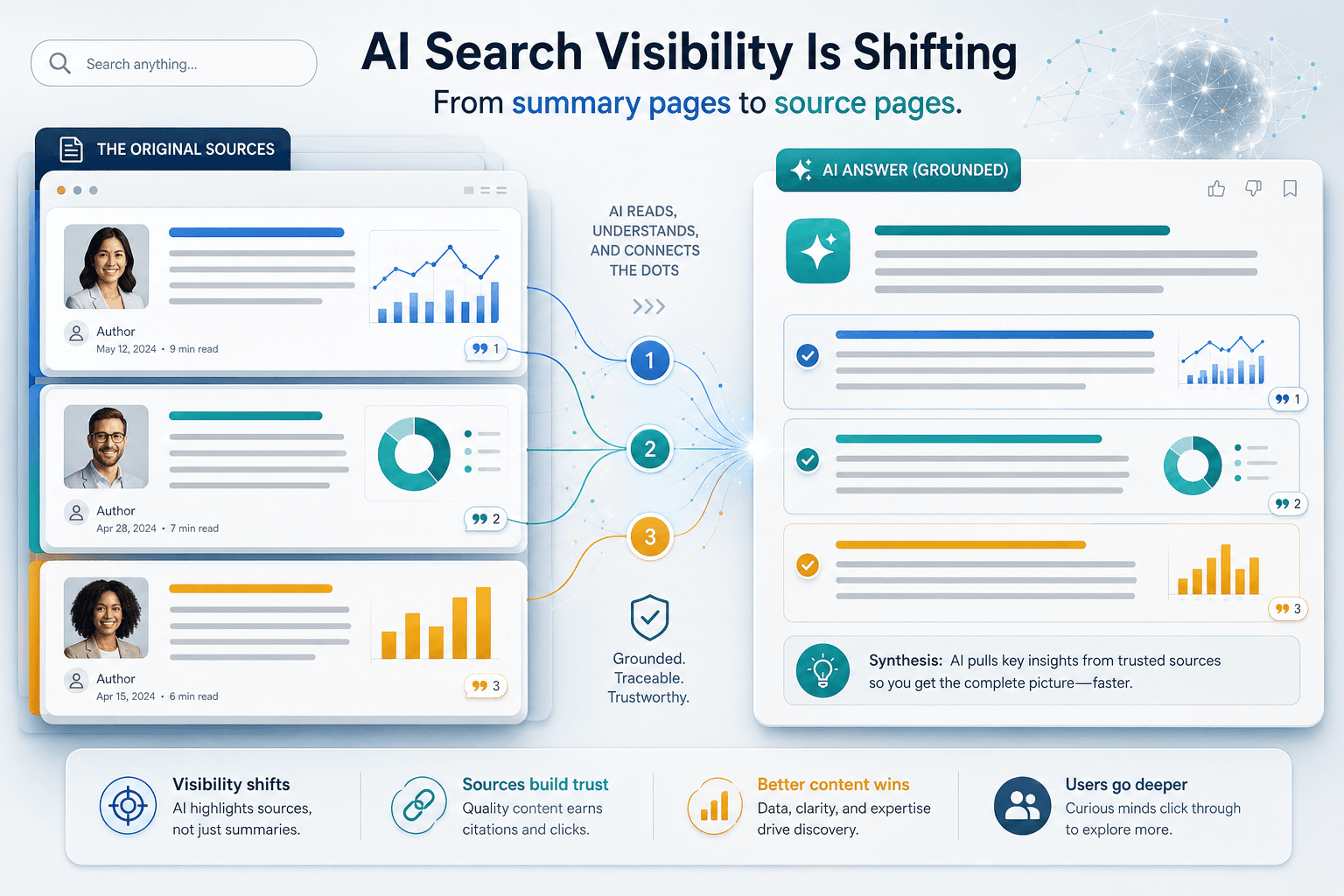
SEOAI Search Is Starting to Separate Source Pages from Summary Pages
Google, Bing, and Perplexity are moving toward citation-worthy source content. Learn what separates a source page from a recap page and how to adapt your content strategy.
Read SEO
SEOWhat Is Answer Engine Optimization (AEO) in 2026?
AI search engines pull answers differently than Google. AEO structures your content so ChatGPT, Perplexity, and Gemini can find, trust, and cite your pages.
Read