AI Search Is Starting to Separate Source Pages from Summary Pages
Google, Bing, and Perplexity are moving toward citation-worthy source content. Learn what separates a source page from a recap page and how to adapt your content strategy.
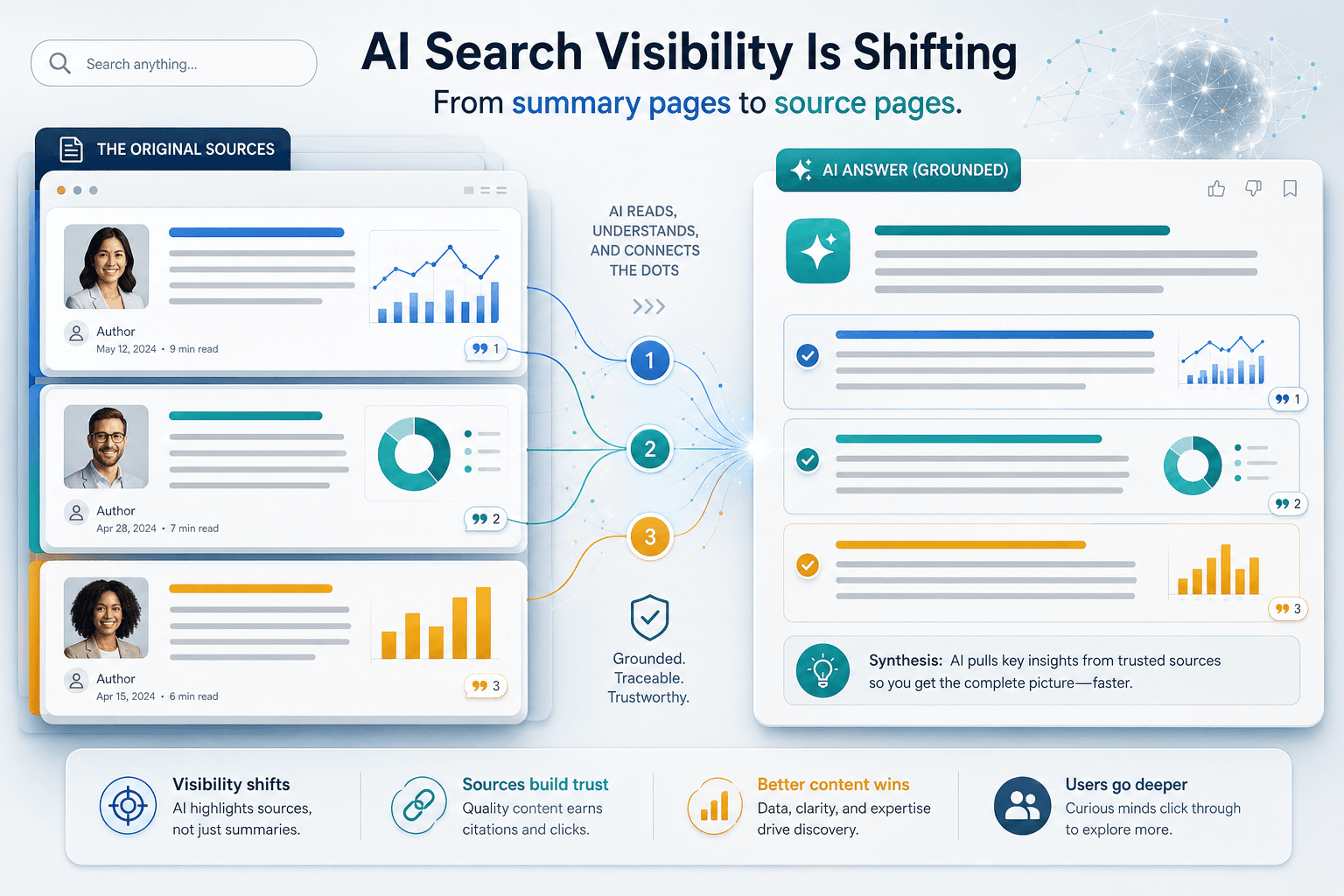
One of the clearest AI search shifts happening right now is that platforms are getting significantly better at separating source content from summary content. It is not a subtle technical change. It is reshaping which pages get cited, surfaced, and clicked — and which ones quietly drop off the map.
Google's latest AI Mode and AI Overviews updates are surfacing more original voices, more inline links, and more previews of what is actually on the page before a user ever clicks. Bing's recent search platform posts make the distinction explicit: traditional search ranked pages for humans, but AI answers need groundable information with provenance, freshness, and clear conflict handling. Perplexity's Premium Health Sources pushes the same logic even further in a category where trust is everything.
The direction is consistent across platforms. If your content mainly paraphrases what already exists, it may still rank in traditional results. But it is less likely to become the source an AI system leans on when building an answer.
What is a source page versus a summary page
A source page is where information originates. It carries expert authorship, documented evidence, direct observations, or primary data. It is the page an AI system can point to and say: this is where the claim comes from.
A summary page recaps what other sources have said. It aggregates, generalises, and rephrases. That served a useful function in traditional SEO. In AI-driven search, it creates a problem: the AI already knows how to summarise. It does not need your summary. It needs your original input.
This is the shift that a lot of content teams have not fully registered yet. The question is no longer just whether your page covers the topic. It is whether your page adds something that cannot be easily generated from what already exists.
Why Google, Bing, and Perplexity are all moving in the same direction
The reason is grounding. AI-generated answers that lack provenance tend to produce errors, outdated information, and low-trust outputs. To reduce that, the platforms are building systems that prefer content they can verify, attribute, and anchor to a specific source.
Google's AI Overviews documentation describes citations as central to how answers are constructed and validated. Bing's search team has described their shift as moving from matching pages to supporting AI answers — and that requires knowing who made a claim, when it was made, and what supports it. Perplexity's decision to add curated health sources shows what happens when a platform decides citation quality matters more than coverage volume.
Three different platforms, three different implementations, the same underlying logic: freshness, provenance, and original contribution matter more than they used to.
A practical AI visibility checklist
If you are reviewing your content against this shift, these are the questions worth asking for each page.
Does it originate something? That could be a data point, a direct quote from a customer, a test result, a documented process, a clear expert opinion with a name attached. Anything your page says that cannot be found exactly like that somewhere else already.
Does it show where claims come from? Data, documentation, customer outcomes, benchmarks, direct tests. The source does not have to be academic. It has to be real and visible.
Does it separate opinion from evidence? Pages that blur analysis with assertion are harder to cite reliably. AI systems favour content where the structure makes it easy to extract a specific verifiable claim.
Does it carry authorship? Expert names, publication dates, and update notes belong on the page itself, not buried in a footer or omitted entirely.
Is it refreshed when facts change? Stale information on a high-stakes page is an active liability in AI search, not just a missed opportunity.
What this means for content strategy
If you are producing content mainly designed to cover a topic broadly, the AI search environment does not reward that the way it used to. Broad coverage pages face more competition from AI systems that can synthesise topic coverage faster than any human writing team.
The space where human content retains clear value is: things that AI systems cannot fabricate with confidence. Original customer documentation. Internal data with real context. First-person expertise on specialised problems. Regional knowledge with verifiable detail. Direct comparison based on hands-on use.
That means the editorial question has shifted. It used to be: have we covered this topic well? Now it is also: have we contributed something to this topic that can only have come from us?
Source page characteristics worth building toward
Based on where search platforms are moving, a strong source page in 2026 tends to have a few distinguishing features. It names the people responsible for the content. It documents where key claims come from. It shows update history for time-sensitive material. It uses structured data to help machines understand the entities, facts, and relationships on the page. And it answers likely follow-up questions in the same place, reducing the need for a user to leave and verify elsewhere.
None of that requires scientific formatting or academic citation style. It requires content that was produced with intention: written by people who actually know the subject, supported by visible evidence, and structured for clarity rather than just keyword density.
The teams that win AI visibility will optimise for citation-worthiness
The shift is not about abandoning SEO. It is about extending its scope. Rankings still matter. Traffic still matters. But citation-worthiness is now part of the same system.
If a platform is building an AI answer about your category and the best-evidenced, freshest, most clearly attributed page in that category is yours, you have a structural advantage. That advantage is not guaranteed by publishing volume or keyword optimisation alone. It is built by consistently producing content that earns the right to be credited as a source.
That is a higher bar in some ways. In other ways it is a more durable one, because it is harder to copy and harder to outrun with content at scale.
Where are you seeing this shift first in your own category: documentation, product pages, editorial, or thought leadership?
Written by Shree Krishna Gauli and reviewed for accuracy under our editorial policy · Last updated June 25, 2026.
More from the journal.
 SEO
SEOAEO and GEO: How to Rank While AI Keeps Reshaping SEO
Learn how AEO and GEO fit into modern SEO, what still matters, and how to rank in AI-driven search experiences without chasing shortcuts.
Read SEO
SEOHow to Optimize Your Website for AI Search Engines
AI search tools extract answers, they do not rank pages. Optimizing for ChatGPT, Perplexity, and Gemini means rethinking structure, schema, and citations.
Read