Most SEO Reports Are About to Look Incomplete
Classic SEO metrics no longer tell the full story. Learn how to build an AI visibility dashboard that tracks citations, AI-assisted visits, and answer-engine performance alongside traditional rankings.
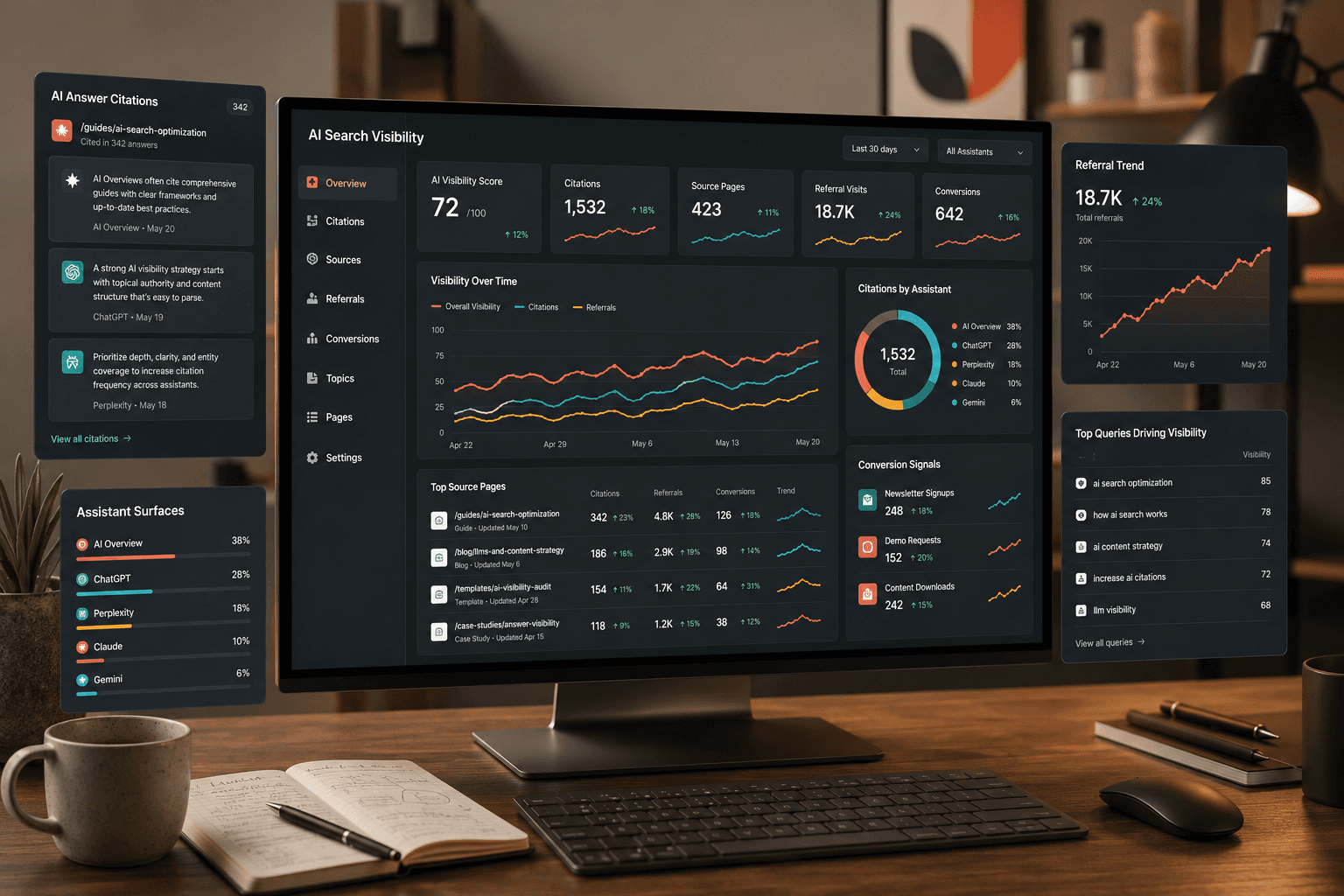
SEO teams need a new reporting layer. The change is not dramatic, but it is consequential. We used to ask: where do we rank? Now we also need to ask: where are we being cited, surfaced, and converted inside AI answers?
Those are not the same question. And most dashboards built in the last five years are only equipped to answer the first one.
Why classic SEO reports are no longer complete
Google has confirmed that AI Mode is now counted inside Search Console totals. That sounds like a minor technical detail. It is not. It means the traffic and click data you are reading in Search Console already includes AI-influenced interactions, but you have no way to separate them from traditional organic results inside the same report. You are measuring a blended number without knowing the blend.
Bing has gone further. Its AI Performance reporting gives publishers visibility into citation activity inside generative answers — meaning you can start to see where your pages are being used as sources, not just where they rank. That is a different kind of data. It tells you not just whether users found you, but whether the AI found you trustworthy enough to credit.
ChatGPT, Claude, and Perplexity are all pushing search and research into more assistant-led workflows. When a user asks one of those tools a question about your category, your page either gets cited or it does not. That outcome is invisible in Google Analytics. It is invisible in most SEO platforms. But it is influencing purchasing decisions, brand perception, and traffic quality every day.
The gap between ranking and citation
There is a growing gap between pages that rank well in traditional search and pages that get cited in AI answers. They are not the same pages, and they do not succeed for the same reasons.
A page that ranks well in traditional search may have strong backlink authority, solid keyword coverage, and good technical foundations. That still matters. But an AI system choosing which source to cite is making a different kind of judgement. It is asking: is this page the clearest, freshest, most specific answer to this question? Is the claim attributable? Is the evidence visible? Is the page likely to be accurate as of today?
Teams that assume their top-ranking pages are also their top-cited pages are making a measurement assumption they have not actually tested. In most cases, the overlap is real but incomplete. The divergence is where the opportunity lives.
What an AI visibility dashboard should track
The practical next step is building a reporting layer that sits alongside your existing SEO dashboards. It does not replace them. It extends them into the territory that classic tools do not cover.
A useful AI visibility dashboard would track the following:
Cited URLs by topic. Which pages are being surfaced as sources in AI-generated answers across Google AI Mode, Bing, Perplexity, and ChatGPT search? This requires manual spot-checking and query monitoring, but it can be systematised.
Landing pages receiving AI-assisted visits. Search Console is beginning to surface some of this through its AI Mode reporting layers. The goal is to identify which pages are receiving traffic that originated from AI-generated answer surfaces rather than traditional blue-link results.
Assisted conversions from AI surfaces. When AI search drives a visit that converts, that conversion looks identical to any other organic visit in most analytics setups. Adding UTM-level clarity or using GA4 attribution models helps isolate AI-assisted paths to conversion.
Source freshness for key commercial and informational pages. High-stakes pages — pricing, service descriptions, case studies, key how-to guides — should have visible last-updated dates and regular review cycles. Pages that go stale in fast-moving categories lose citation potential quickly.
Gaps between high-ranking pages and high-citation pages. This comparison is the most valuable output. A page that ranks in position two for a competitive keyword but never gets cited in AI answers is telling you something important about its evidence quality, its structure, or its perceived trust.
What this means for how you report upward
If you report SEO performance to a client, a founder, or a leadership team, the framing is shifting. Ranking reports are not wrong, but they are now partial. The question leadership increasingly asks is not just whether the site is visible in search. It is whether the business is showing up when customers are researching in AI tools.
That question requires a different answer format. It requires showing where the brand appears in AI-generated responses, not just where it ranks on a traditional SERP. It requires explaining the difference between a cited source and a ranked page. And it requires framing AI visibility as an operational measurement problem, not just a content quality problem.
Teams that learn this vocabulary in 2026 will find it much easier to justify editorial investment, technical SEO work, and structured data improvements to stakeholders who might otherwise see them as abstract.
Classic metrics still matter — but they are no longer enough on their own
None of this means abandoning what works. Organic rankings still drive meaningful traffic. Domain authority still influences perception and AI citation in indirect ways. Technical health still determines whether pages can be properly crawled, indexed, and understood.
But the frame has expanded. The teams that learn fastest in 2026 will not just optimise for rankings. They will measure answer-engine visibility the way they measure any other operating metric: with specific KPIs, regular review, and clear ownership.
The report that only shows keyword positions is increasingly the report that is missing half the picture. The teams that recognise that early are the ones who will have the advantage when the rest of the industry catches up.
What is the first metric you would add to your AI visibility dashboard?
Written by Shree Krishna Gauli and reviewed for accuracy under our editorial policy · Last updated June 25, 2026.
More from the journal.
 Growth Strategy
How to Write a Case Study That Actually Wins Clients
A good case study does more than show off. It walks a prospect through a problem like theirs and proves you can solve it. Here is the structure I use.
Read Hiring
Freelancer vs Agency: Which Marketing Partner Fits You?
The right answer depends on decision speed, complexity, and how much senior attention you need. A simple framework for choosing the right fit.
Read