How to Use Google Search Console Data for AEO
Search Console is the most reliable free signal you have for answer engine optimization. Here is how to read queries, impressions, and position data to find AEO opportunities and act on them.

TL;DR
Search Console will not label results as AEO, but its data points straight at the opportunities. Find question-style queries you already get impressions for, pages with high impressions but low clicks, and terms sitting in striking distance. Then restructure those pages to answer the question directly, add schema, and track whether impressions and position improve.
Answer engine optimization can feel like guesswork because the AI engines do not hand you a tidy report. But you already own a strong, free signal: Google Search Console. It shows what people search, how often you appear, and where you sit. Read it the right way and it becomes an AEO opportunity map.
This is the practical companion to choosing tools. If you have not yet sorted your stack, start with how to choose an AI platform for SEO and AEO, then come back here for the measurement side.
Why Search Console still matters for AEO
AEO is about being the answer to a question. Search Console records the questions people actually ask and whether you show up for them. Even when an AI Overview sits above the classic results, the underlying query demand and your impressions are still captured, which makes it the most reliable free baseline you have.
The reports that reveal AEO opportunities
Question-style queries
In the Performance report, filter queries for words like how, what, why, best, vs, and near me. These are the searches AI answers love. Any question you already get impressions for is a page you can restructure to answer it directly and win the snippet or citation.
High impressions, low clicks
Sort by impressions and look for queries with many impressions but a weak click-through rate. That gap often means an AI answer or a competitor is capturing the click. These are your highest-leverage AEO targets, because the demand is already proven.
Position in striking distance
Average positions between roughly five and fifteen are within reach. A focused rewrite, better structure, and schema can move these onto the first screen and into answer eligibility far more cheaply than chasing brand-new terms.
Pages, not just queries
Switch to the Pages tab to see which URLs earn impressions. If an important service page barely registers for its own topic, that is a structure and content problem worth fixing before you write anything new.
Turning the data into AEO actions
- Take a proven question query and add a clear, direct answer near the top of the matching page.
- Use descriptive headings that mirror how people ask, so both readers and engines can extract the answer.
- Add or fix FAQ and other schema that reflects the visible content, never hidden text.
- Strengthen the entity: a clear About page, consistent business details, and internal links to related topics.
- Re-check the same queries in two to four weeks to see if impressions and position improved.
What Search Console cannot tell you yet
Search Console does not break out AI Overview citations cleanly, and it tells you little about non-Google assistants. So pair it with manual checks: search your target questions in the AI engines and note who gets cited. Treat that as qualitative color on top of the quantitative Search Console baseline.
Used consistently, this loop of read, act, and re-measure is most of what good AEO is. It is the same method behind my AEO services in Dallas and my SEO consulting work. If you want a Search Console review that turns your impressions into a prioritized plan, get in touch.
Written by Shree Krishna Gauli and reviewed for accuracy under our editorial policy.
More from the journal.
 SEO
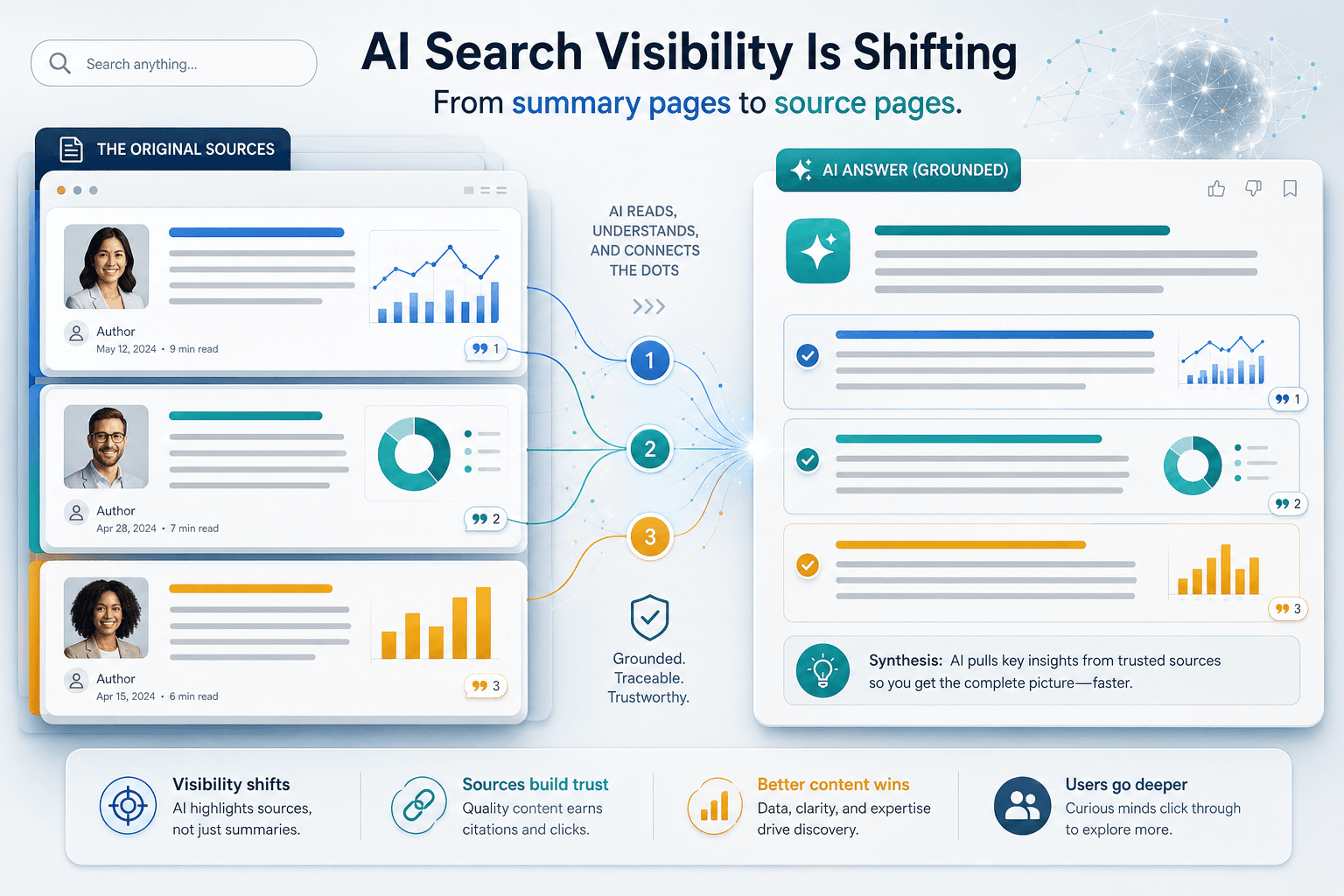
SEOAI Search Is Starting to Separate Source Pages from Summary Pages
Google, Bing, and Perplexity are moving toward citation-worthy source content. Learn what separates a source page from a recap page and how to adapt your content strategy.
ReadSEOWhat Is Answer Engine Optimization (AEO) in 2026?
AI search engines pull answers differently than Google. AEO structures your content so ChatGPT, Perplexity, and Gemini can find, trust, and cite your pages.
Read