AI Visibility Is Becoming an Evidence Problem, Not Just a Ranking Problem
ChatGPT, Perplexity, and Google AI Mode are selecting sources based on evidence quality. Learn the 2026 content standard that makes your pages easy to cite, extract, and trust.
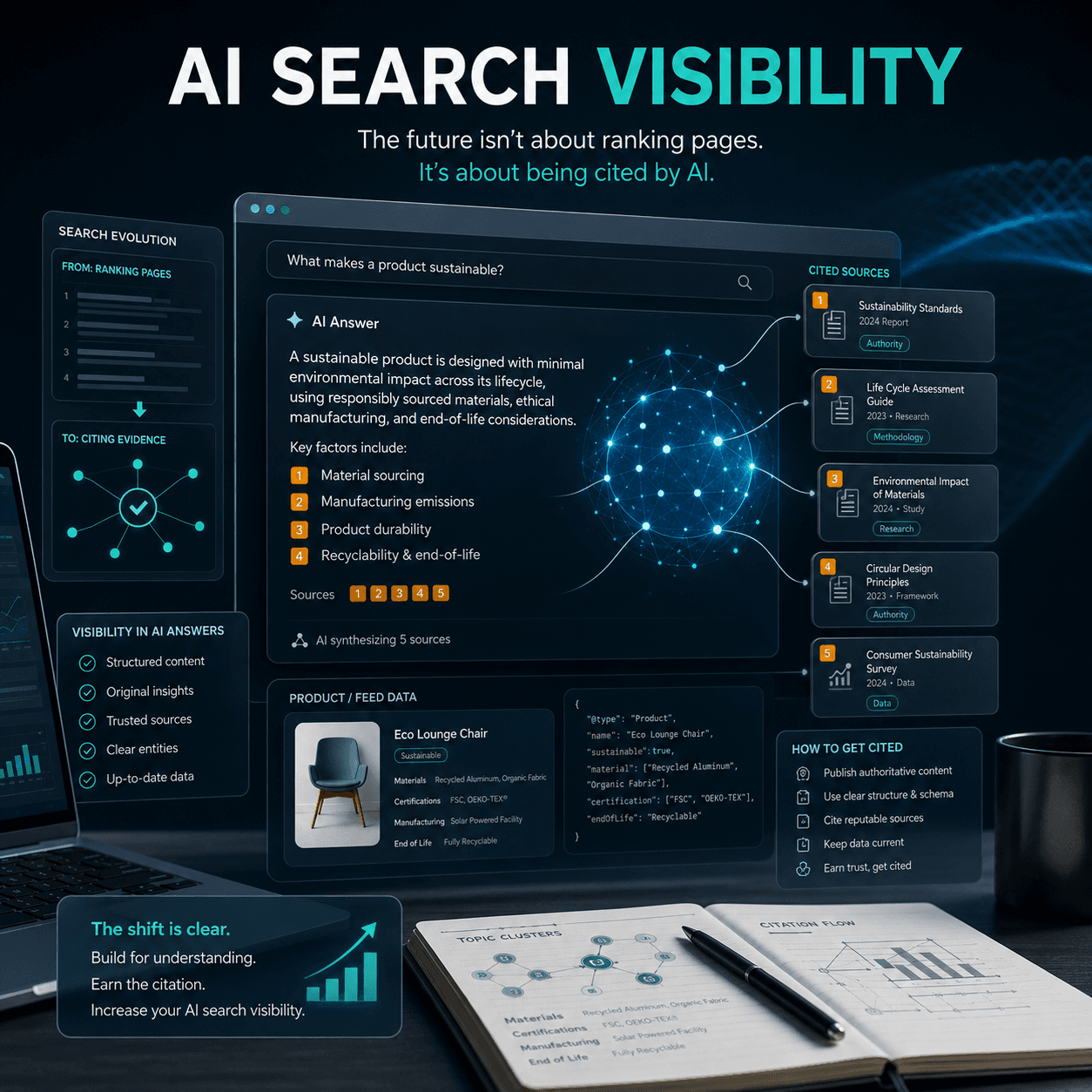
In the last few weeks, Google has pushed AI Search further toward source exploration, with more inline links, more content previews, and more clear pathways into original content before a user clicks. Bing has gone even more direct, describing the platform shift as moving from ranking pages for humans to supporting answers for AI systems.
That distinction matters more than it might sound. ChatGPT, Claude, Perplexity, and other answer engines are not simply listing pages. They are retrieving facts, comparing sources, synthesising responses, and making a judgment call about what is strong enough to cite. The standard they apply is not just relevance. It is reliability, clarity, and extractability.
So the practical question is no longer only: how do I rank? It is also: can an AI system extract a clear, fresh, attributable fact from this page without guessing?
Why evidence quality is the new differentiator
Traditional SEO rewarded coverage. If your page covered the right keywords, matched the right intent, and had enough authority behind it, it could rank well even if the underlying content was vague, indirect, or padded.
AI search systems apply a different filter. They are not just matching queries to documents. They are trying to construct reliable answers, and reliability requires knowing that a claim is specific, supported, and current. Vague content produces uncertain outputs. Uncertain outputs are a trust problem for the platform.
That means content that worked in traditional search because of its breadth now faces a harder test. The AI system does not need broad coverage. It can synthesise that itself. What it cannot synthesise is your original data, your direct customer evidence, your documented expertise, or your specific institutional knowledge. That is the content it will prefer to cite.
The implication is significant: the pages that will perform best in AI search over the next two to three years are not necessarily the ones with the most volume, the most links, or the widest topical footprint. They are the ones with the clearest, best-evidenced answers to specific questions.
What a strong 2026 content standard looks like
Based on how Google, Bing, and the major AI platforms are communicating about source selection, a page that performs well in AI search in 2026 tends to have several qualities in common.
One page, one clear job. Pages that try to answer five different questions for five different audiences tend to produce diluted answers that are harder to extract from. A page that knows exactly what it is for — what question it answers, for whom, at what stage of decision — is more likely to be selected because its signal is cleaner.
Important claims stated plainly. AI systems extract meaning more reliably from direct, confident statements than from qualified, hedged, or passive constructions. That does not mean eliminating nuance. It means leading with the answer before the explanation, not burying it inside a paragraph of context.
Visible update dates on time-sensitive content. For content that covers topics where facts change — pricing, platform features, statistics, regulatory guidance — a visible last-updated date is a trust signal to both users and AI systems. A page with a 2022 update date on a topic that changed in 2025 will be deprioritised.
Strong source attribution and authorship. Who wrote this? What do they know? Where does the data come from? These questions used to be answered implicitly through domain authority. In AI search, they need to be answered explicitly on the page.
Structured product, local, or entity data where relevant. Schema markup helps AI systems understand what a page is about without having to infer it from prose. For product pages, local service pages, and author profiles, structured data is not optional anymore. It is a clarity investment.
Supporting detail that answers likely follow-up questions. A page that answers the main question well but leaves obvious follow-ups unanswered forces the AI to combine multiple sources. A page that anticipates the next question and addresses it in the same place earns more complete citation coverage.
Different content types, same underlying logic
The application of this standard varies by content type, but the underlying logic is consistent.
If you sell products, feed quality now matters alongside page quality. AI shopping experiences draw from structured product data, not just prose descriptions. A well-written product page with incomplete or outdated structured data is a weaker candidate than a clearly structured page with accurate, current feeds.
If you publish expertise, provenance matters alongside polish. A beautifully written article with no visible author, no date, and no evidence trail is a weaker source than a plainly written one that clearly documents who produced it, when, and on what basis.
If you want AI search visibility more broadly, the mindset shift is from copywriter to publisher of evidence. A copywriter asks: does this read well and convert? A publisher of evidence asks: is this true, specific, attributable, and current? Both matter. But in AI search, the second question is carrying more weight than it did two years ago.
The teams that adapt fastest will be the easiest to cite
This is not a crisis for content teams that already prioritise quality over volume. If you have been building pages that genuinely answer specific questions with documented evidence and visible expertise, you are already ahead of the adjustment curve.
The harder adaptation is for teams that built content strategies around coverage and keyword density. That approach produced substantial organic traffic when matching a keyword was enough to rank. In AI search, matching a topic is not the same as being trustworthy enough to cite.
The good news is that the adjustment is practical. It does not require starting over. It requires identifying which pages are doing well on evidence quality already, which need strengthening, and which are unlikely to be competitive in AI search regardless of how much they are optimised for traditional search signals.
That is a prioritisation exercise as much as a content exercise. And the teams that run it clearly in 2026 will not be the loudest in AI search results. They will be the ones that the platforms trust enough to keep citing.
What are you changing first: page structure, schema, freshness, or source quality?
Written by Shree Krishna Gauli and reviewed for accuracy under our editorial policy · Last updated June 25, 2026.
More from the journal.
 Growth Strategy
How to Write a Case Study That Actually Wins Clients
A good case study does more than show off. It walks a prospect through a problem like theirs and proves you can solve it. Here is the structure I use.
Read Hiring
Freelancer vs Agency: Which Marketing Partner Fits You?
The right answer depends on decision speed, complexity, and how much senior attention you need. A simple framework for choosing the right fit.
Read